

Why Data Centres Are Moving Light Sources Onto the Chip Itself
Optical fibres already carry data between data centre racks at the speed of light, but the electrical wiring inside each switch has become the bottleneck, so engineers are now packing lasers and light-guiding circuits directly onto the same package as the processor.
The problem is not the fibre, it’s the last few centimetres
Modern data centres already use optical fibre to move information between buildings, rows of racks, and even individual servers. Light travels through glass fibre with very little loss and no interference from other signals nearby, which is why it replaced copper cabling for anything beyond a short distance decades ago.
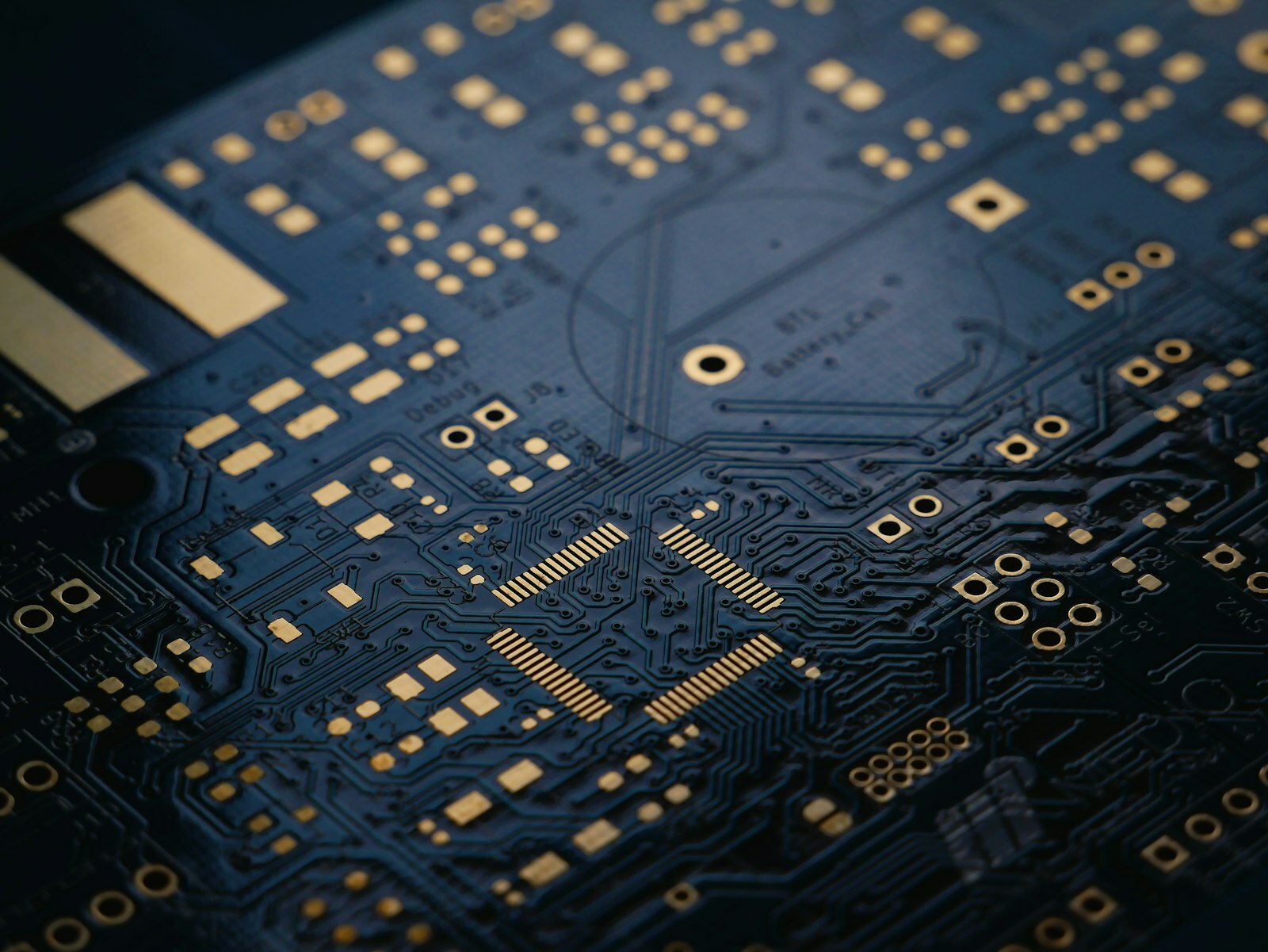
The part that has not caught up is the connection between the fibre and the chip that actually processes the data. Traditionally, a network switch or processor sends and receives information electrically, over short copper traces on a circuit board, to a separate module that converts it into light and pushes it out onto a fibre. That conversion module, often called a pluggable optical transceiver, sits at the edge of the board, some distance from the chip itself.
As chips have got faster and data centres have started moving vastly more traffic, largely driven by the demands of training and running large AI models, those short copper traces have become a real constraint. Electrical signals lose strength and get noisier the faster you push them and the further they travel, even over a few centimetres of circuit board. Engineers describe this as the signal integrity problem, and it means more power is spent simply cleaning up and re-driving electrical signals so they survive the short hop to the transceiver.
Bringing the light source home
Co-packaged optics is the industry’s answer: instead of converting electrical signals to light at the edge of the board, the light-generating and light-detecting components are mounted right next to the switching or processing chip, inside the same package. Some designs go further and integrate the optical components onto the same piece of silicon as the electronics, using a manufacturing approach called silicon photonics, which borrows the same fabrication techniques used to make ordinary computer chips.
The electrical signal now only has to travel a few millimetres, rather than several centimetres, before it becomes light. This shortens the distance over which the signal can degrade, which in turn means less power is needed to drive it, less heat is generated, and the equipment can be packed more densely without overheating.
This matters because power and heat, not raw processing speed, are increasingly the limiting factors in large data centres. A rack that runs hotter needs more cooling, which itself consumes energy and space. Shrinking the electrical portion of the journey, even by a small physical distance, has a disproportionate effect on the total power budget of a large facility.
Why it is hard to do well
Moving delicate optical components inside a chip package sounds simple in principle but creates several genuine engineering headaches. Lasers generate heat, and heat is precisely what you are trying to manage close to a processor. If a laser fails, the entire package may need replacing rather than a single pluggable module being swapped out during routine maintenance, which changes how data centre operators think about repair and spare parts.
Aligning optical fibres to components that are now inside a sealed package, rather than accessible at the edge of a board, also demands extremely precise manufacturing, since a misalignment of a fraction of a micron can noticeably weaken the signal. And because the optical and electronic parts are now made or assembled together, any fault in either affects the whole unit, so testing and yield management become more demanding than for conventional chips.
Where this fits into the bigger picture
Co-packaged optics does not replace the fundamental principle that photonic technology relies on: using particles of light, rather than the flow of electrons, to carry information, because light signals can be packed closer together in a fibre and do not generate resistive heat the way current does moving through a wire. What co-packaged optics changes is how close to the processor that switch to light happens.
This approach is currently most relevant to the largest data centre operators and network equipment makers, since the cost and complexity of the technology only pays off at scale. It is not something that will appear in a home broadband router any time soon. But as AI workloads keep demanding faster, lower-power connections between huge numbers of processors, the physical distance between the world of electrons and the world of light inside a data centre looks set to keep shrinking.
For readers wanting to track how this technology is being adopted in practice, the UK’s research and standards bodies periodically publish accessible material on photonics and data infrastructure, and it is worth checking primary sources directly rather than relying on marketing claims from any single vendor.